



















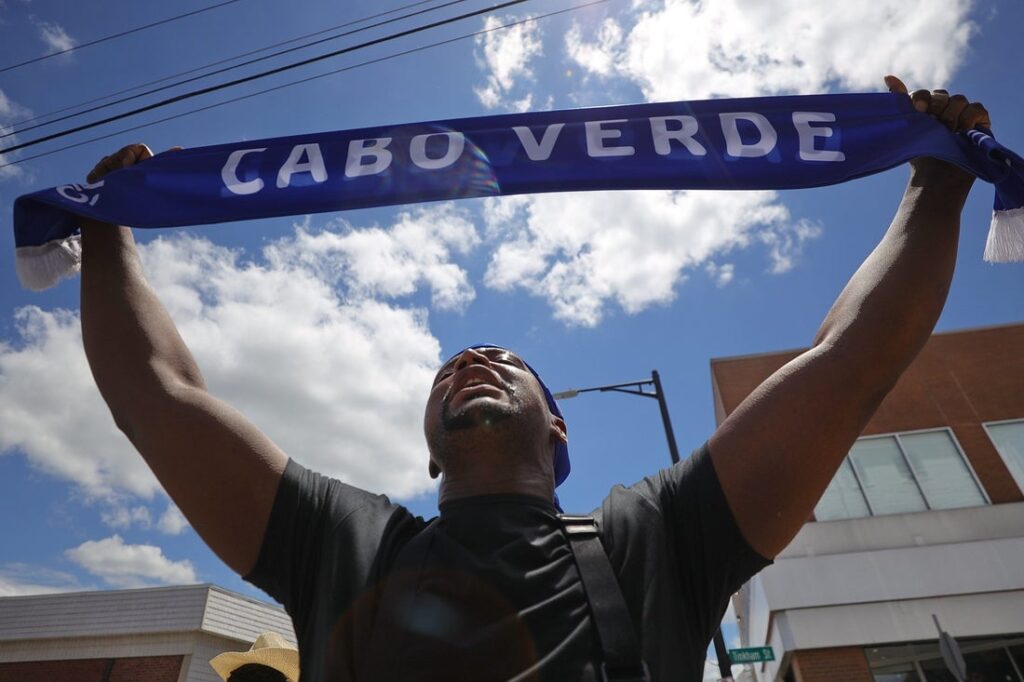
Cape Verde’s historic 0-0 draw against Spain on Monday in Atlanta delivered a triumphant blow for all smaller nations whose inclusion in the first 48-team World Cup has drawn derision from more established corners of the soccer world.
And their coach knows it.
Speaking after his side’s resilient performance against the defending European champions, Cape Verde manager Pedro Leitao Brito reiterated his belief that his side and others benefiting from the expanded format should not feel any need to apologize.
“I think that we have to congratulate the so-called ‘minor’ teams for their organization and for the work that they have carried out with their national teams,” Leitao Brito said through an interpreter. “This is a more open world now, and smaller national teams are more entitled to face higher-level teams.”
That may be particularly true in Africa, which has gained four additional World Cup automatic berths as a result of expansion.
And even with a record 10 African teams competing (with DR Congo qualifying through inter-confederation playoffs), the continent still faces the hardest mathematical odds of reaching the tournament from 53 qualifying entrants.
Yet the juxtaposition of qualifying failures like that of four-time World Cup champions Italy against unfamiliar debutants like Cape Verde has drawn some derision and suggestions that the tournament has become less rigorous.
There was even a report from Slovenian outlet Zurnal 24 that UEFA president Aleksander Ceferin had said the expanded format leads to “a huge number of matches that are completely uninteresting.”
In response, all 10 competing African nations plus Curacao, Haiti and Uzbekistan signed onto a joint statement to “firmly reject” that sentiment and insist “football does not belong to a select group of nations.”
For Leitao Brito, who played 21 times for Cape Verde between 1989 and 2005, the biggest benefit of his team reaching this stage is the opportunity to prove their abilities to themselves.
All of his international appearances came before Cape Verde qualified even for their first African Cup of Nations in 2013.
“Of course it gives us more stability,” he said. “We have spent a long time working on that, and we have some players that have been through hardships. But there was always a bit of a difficulty before. But nowadays, we may lose against those teams, but our posture, our standing is sound, because the players know that they can compete.”
Through five days of the World Cup, African teams have performed respectably, posting one win and three draws in six matches.
In addition to Cape Verde’s shocking draw, highlighted by seven saves from the 40-year-old Vozinha, Ivory Coast earned a 1-0 victory to halt Ecuador’s 19-match unbeaten run on Sunday night in Philadelphia. Later Monday in Seattle, Egypt played a talented Belgium squad to a 1-1 draw.
Cape Verde were the first debutant in this tournament to earn a point after Haiti lost 1-0 to Scotland and Curacao fell 7-1 to Germany. Uzbekistan make their debut against Colombia on Wednesday night in Mexico City.
“Before coming here, I’ve said that our purpose was to compete at the highest level,” Leitao Brito said of his team. “We would face difficulties for sure, but we are going to do our utmost to overcome hurdles.”
–Ian Nicholas Quillen, Field Level Media