




















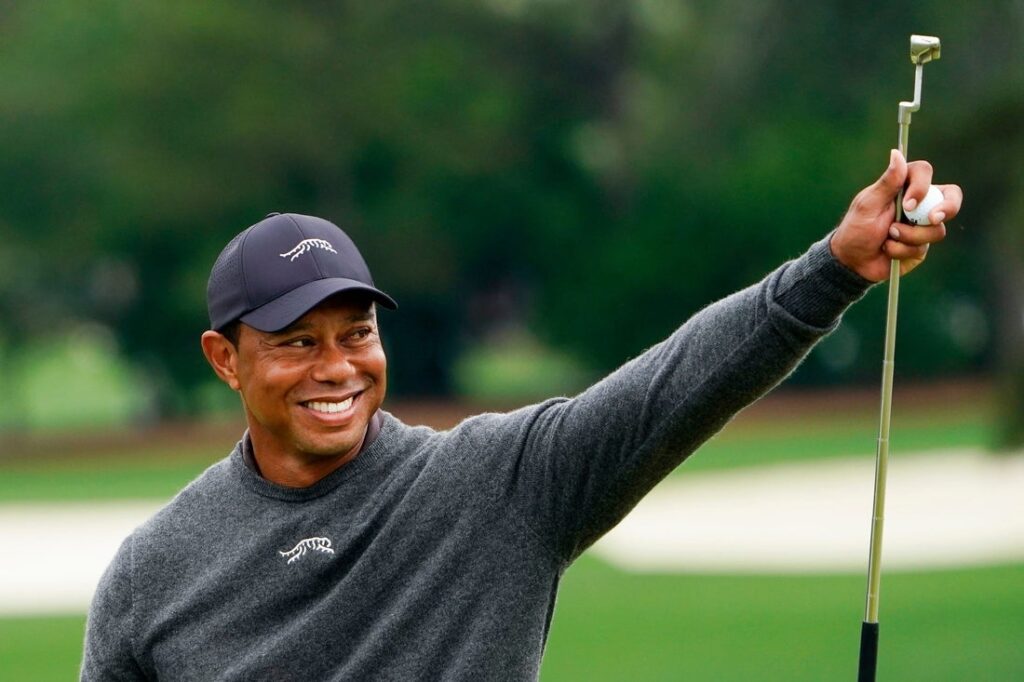
It has been nearly 18 months since Tiger Woods competed in a PGA Tour event.
But even in his injury-riddled absence, he has been heavily involved in planning the tour’s future.
PGA Tour CEO Brian Rolapp appointed the 15-time major champion as the chair of the tour’s Future Competition Committee in August, saying the nine-member committee “will undertake a comprehensive review of the current competitive model and shape the future of TOUR competition,” in order to define “the optimal competitive model that enhances the PGA TOUR’s value to fans, players and partners.”
Woods, talking Tuesday ahead of the Hero World Challenge in the Bahamas, discussed what those talks have been like hours before the committee’s first formal meeting that day.
“We’re trying to figure out what is the best schedule possible so we can create the best fields and have the most viewership and also the most fan involvement and what does that look like,” Woods said. ” … Looking at different timetables of when we start and finish, different tent poles throughout the year and what that might look like.”
The buzz, fueled in part by November comments made by Harris English, is that the PGA Tour is considering moving the start of its season, which currently begins in mid-January, to mid-February and decreasing the season length to about 20 tournaments in an effort to not overlap and compete with the NFL for viewership.
That’s a talking point Woods made back in 2005, when he said he believes the season should end around Labor Day so that it doesn’t compete with the NFL.
A talking point of Rolapp’s since taking over as CEO this summer has been that the PGA Tour’s future scheduling will be guided by the three pillars of scarcity, competitive parity and simplicity, only one of which (parity) it has at the moment.
Woods weighed in publicly for the first time on these tenets this week.
“Parity is something that’s inherent in the game of golf because of the meritocracy of the game. It’s just there, we already have parity. We play each and every week starting at zero. So with the parity part, it was the easiest part to figure out because it’s already there,” Woods said. “Now, the simplicity part, that’s another part that you didn’t say that we have to try and simplify. Simplify the point structure on the FedExCup so not only the players understand but the fans can understand it, what goes on every week, week to week, how they can follow and how we can make it better.
“And the scarcity thing is something that I know scares a lot of people, but I think that if you have scarcity at a certain level, it will be better because it will drive more eyes because there will be less time. But don’t forget the golfing year is long. So there’s other opportunities and other places around the world or other places to play that can be created and have events. So there’s a scarcity side of it that’s not as scary as people might think.”
Woods alluded to 2027 as a potential timeline for a new schedule to be implemented, meaning this upcoming season could be the final one before a significant change.
But he wasn’t willing to commit to it, admitting the change may have to come in waves.
“We are trying to do that in the best way possible so we can introduce this in ’27. Hopefully we get there, hopefully we get to that point. We’re working with all of our partners to create the best schedule and product to deliver all that in ’27 is something we’re trying to do. I don’t know if we can get there, I don’t know if we will get there, but that’s what we’re trying to do.”
–Field Level Media