




















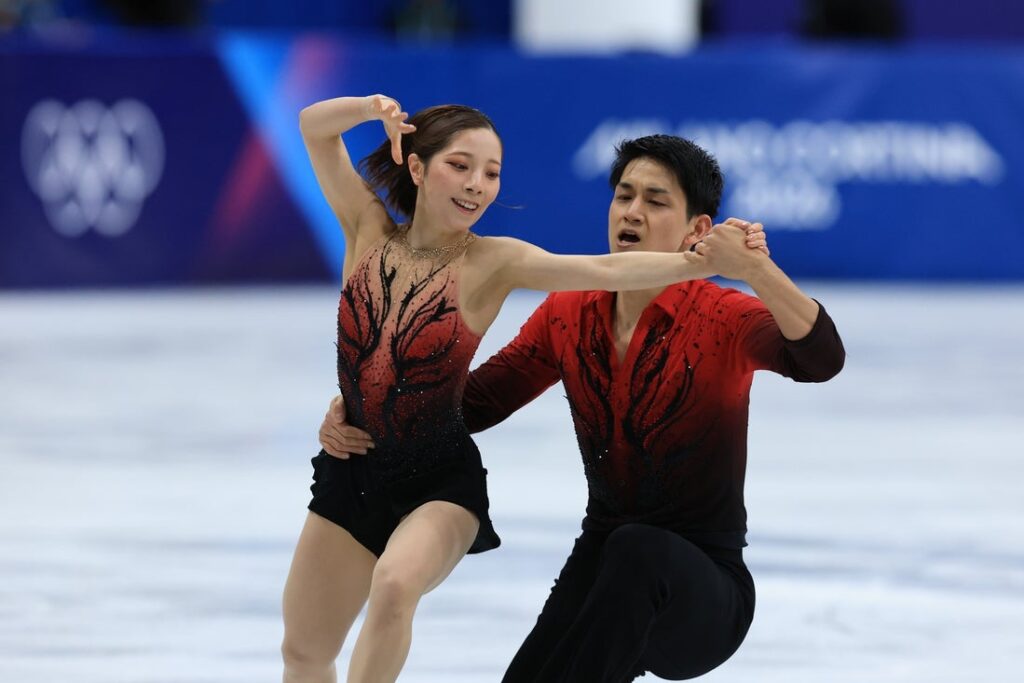
MILAN — Riku Miura and Ryuichi Kihara delivered a thrilling comeback at the Milan Cortina Games, storming from fifth place after a shaky short program to capture Japan’s first Olympic figure skating pairs title on Monday.
Miura and Kihara scored a whopping 158.13 points — a world record under the scoring system that was revamped following the 2018 Olympics — for their spellbinding free program to music from “Gladiator,” performed by Andrea Bocelli, to earn a combined total of 231.24.
That set the bar sky-high for the four teams that skated after them.
Anastasiia Metelkina and Luka Berulava captured Georgia’s first ever Winter Olympics medal when they secured silver with 221.75.
The European champions paid the price for Metelkina stumbling out of her landing on the throw triple loop.
Minerva Fabienne Hase and Nikita Volodin of Germany, the leaders following the short program, had to settle for bronze with 219.09 after Fabienne Hase bobbled the landing of a double Axel and singled a planned triple Salchow.
Miura and Kihara, who teamed up in 2019, had suffered an uncharacteristic error a night earlier when she slipped out of their lasso lift.
When they stepped off the ice on Sunday, coach Bruno Marcotte reminded a devastated Kihara: “It’s not over.”
Turns out, he was right.
“Considering the big mistake that we made yesterday, we feel very proud that we’ve been able to come … back up to this high level today,” Miura said.
Kihara added: “At this point, we still can’t believe that this has happened since yesterday’s performance.
“It’s a little bit of a disbelief, almost, that we’re able to get a medal for Japan pair skating for the first time ever, and we hope that our performance tonight is going to lead Japan skating community into the future to perform better and better moving forward.”
BURST INTO TEARS
Skating with the fearlessness that made them double world champions, the duo erased a near seven-point deficit with a powerful skate that had eluded them 24 hours earlier.
They opened with a soaring triple twist lift, before landing clean triple toe loops and Salchows in perfect synchronization.
With the duo also showcasing a huge throw triple Lutz and a throw triple loop, the Milano Ice Skating Arena crowd were on their feet long before the final strains of the music had died out while Marcotte was leaping up in celebration.
Kihara immediately burst into tears.
About 40 minutes later, once it was confirmed that they had obliterated their nearest rivals by almost 10 points, the overwhelmed Japanese pair fell into a tight embrace, shedding tears of joy onto each other’s shoulders.
“I’m proud of them,” Marcotte said. “I’m happy for them. I think they were ready. Coming here we were extremely confident. The main goal was to be the best today after what happened yesterday.
“They were still a little bit shaken. But the biggest message was: you have to be the best in the world today. Because no matter what happened, in five years, 10 years, 20 years, you want to remember this moment that you gave everything today. I want you to create magic, skate with your heart.”
Marcotte had reminded the skaters how Germany’s Aljona Savchenko and Bruno Massot had sat fourth after the short program eight years ago in the Pyeongchang Olympics but laid down a stunning free skate of 159.31, a world record before the scoring system change, in one of skating’s greatest comebacks.
“I showed them the example (of Savchenko and Massot) who were also trailing by seven points, and they came back and won,” Marcotte said. “But I never, I never stopped believing.”
An emotional Berulava, meanwhile, called winning Georgia’s first Winter Olympic medal “the best day of my life.”
“I’m so very happy,” he said. “It’s an amazing moment for my country. I have no words. I’m shocked.”
China’s 2022 Olympic champions Sui Wenjing and Han Cong, who announced their comeback in June, rebounded from Sui’s fall in their short program to finish fifth.
Canada’s Deanna Stellato-Dudek and Maxime Deschamps, the 2024 world champions, finished 11th following errors in both of their programs.
The 42-year-old Stellato-Dudek, the oldest figure skater competing in an Olympics in almost 100 years, made a remarkable comeback after 16 years away from the sport.
Their Olympics had been in doubt after Stellato-Dudek hit her head in training on Jan. 30.
“Just to be out here and skating on the ice was a privilege and really amazing,” Deschamps said.
–Reuters, special to Field Level Media