

















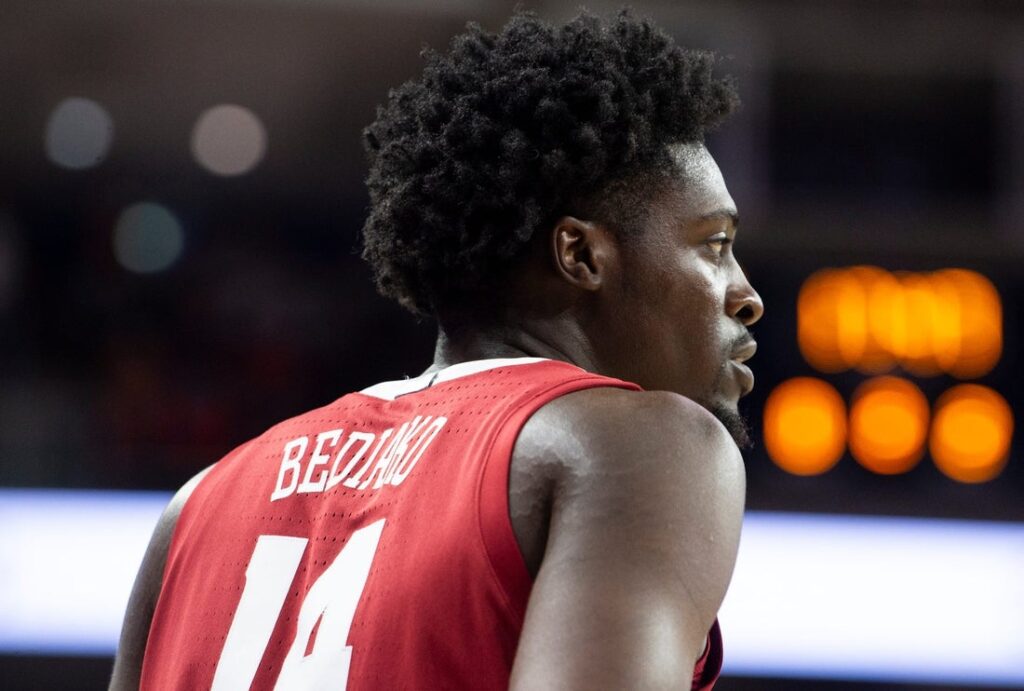
A circuit court judge in Alabama denied Charles Bediako’s motion for a preliminary injunction to continue the resumption of his college basketball career Monday, rendering him ineligible once again.
Bediako last month won a temporary restraining order from the Tuscaloosa County Circuit Court that allowed him to rejoin the Alabama basketball team for the rest of 2025-26, in a challenge to NCAA eligibility rules.
Bediako, 23, played two seasons for Alabama before entering the 2023 NBA Draft and going undrafted. He signed a two-way contract with the San Antonio Spurs but was released before playing in an NBA game. He proceeded to play in 82 games in the G League.
Those factors were enough for County Circuit Court Judge Daniel F. Pruet to decide that Bediako did not have a “reasonable expectation” to be allowed to return to the college game as no prior case existed where a player was granted eligibility under the same circumstances.
Pruet said Bediako “failed to establish that he would suffer irreparable harm,” “failed to establish that he has no adequate remedy at law without the issuance of the injunction” and “failed to demonstrate that he has at least a reasonable chance of success on the ultimate merits of those claims.”
It marks a perhaps unlikely victory for the NCAA at a time when its rules regarding player eligibility have been challenged and overturned in court with frequency.
The NCAA had allowed James Nnaji and other former G League players to be eligible to play because they were not previous college players who left, and because they had not signed NBA contracts. That is where the NCAA drew the line.
“To obtain the benefits promised to him for participation in NCAA basketball, the Plaintiff must be eligible to participate in NCAA basketball,” the judge said. “Eligibility to participate in the NCAA is controlled by the Defendant’s application of the eligibility rules legislated by the NCAA membership.”
Bediako’s original TRO was granted by a different judge, James H. Roberts Jr., who later recused himself from the case on the NCAA’s request because he was listed as an Alabama athletics booster who had made a lifetime contribution of between $100,000 and $249,000 to their foundation.
NCAA president Charlie Baker said in a statement Monday that “Common sense won a round” in the ongoing eligibility tug-of-war.
“The court saw this for what it is: an attempt by professionals to pivot back to college and crowd out the next generation of students,” Baker said. “College sports are for students, not for people who already walked away to go pro and now want to hit the ‘undo’ button at the expense of a teenager’s dream. While we’re glad the court upheld the rules our members actually want, one win doesn’t fix the national mess of state laws. It’s time for Congress to stop watching from the sidelines and help us provide some actual stability.”
Less enthused about the ruling was Alabama coach Nate Oats, who called himself “super disappointed” and felt the case shouldn’t have reached the courts to begin with.
“To me, the NCAA’s point of why Charles shouldn’t be eligible was all these rules that they have, but they’re not applying those rules to all these other players they’ve made eligible,” Oats said on his weekly radio show Monday night. “To me, it was very disappointing in the whole case. Disappointing for Charles.”
A 7-foot center, Bediako played five games (two starts) for Alabama under the temporary restraining order and averaged 10.0 points, 4.6 rebounds and 1.4 blocked shots per game. The Tide went 3-2 in those games.
–Field Level Media