



















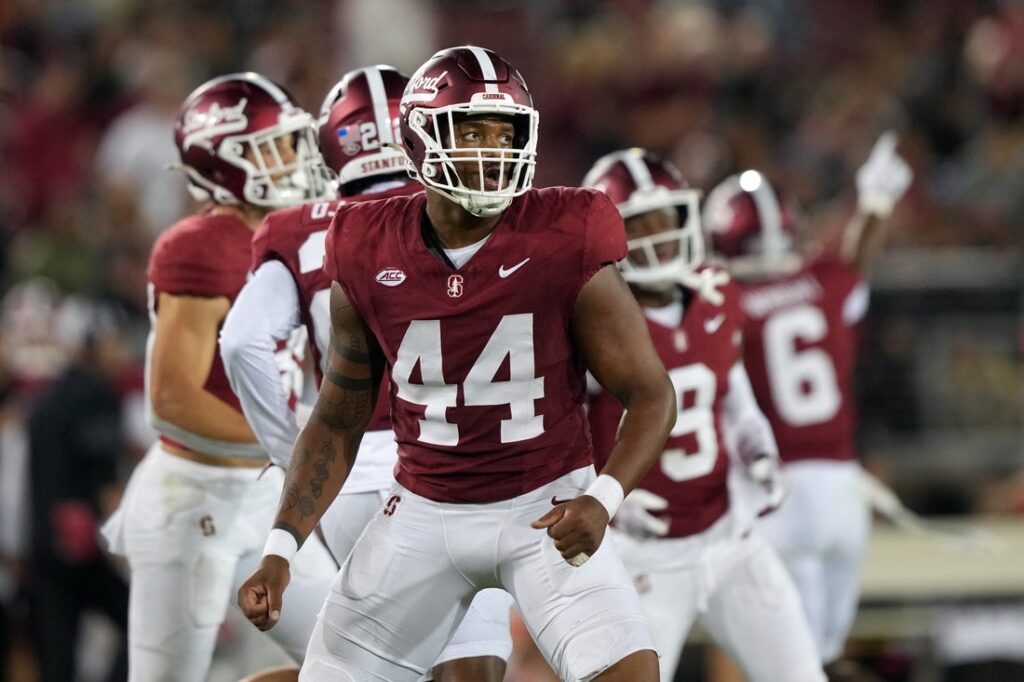
Founded five years ago as an advocacy group for athletes, the College Football Players Association announced on Monday that Stanford football players have formed the CFBPA’s first chapter led by active athletes — a first step toward what the group hopes will eventually become a collective bargaining unit.
Regarding who the athletes will negotiate with, CFBPA founder and executive director Jason Stahl points to the conferences.
“We are very optimistic that other chapters will be announced soon,” Stahl, a former faculty member at the University of Minnesota, told The Athletic.
After communicating with Stanford players for more than a year, Stahl met with more than 50 players at the school’s campus in Palo Alto, Calif., late last month. The Cardinal players elected fifth-year offensive lineman Fisher Anderson and fifth-year linebacker Ernest Cooper as player representatives.
“We (at Stanford) have always had a pretty tight relationship with the NFL Players Association,” Anderson said on a podcast produced by the CFBPA, which was founded with a goal of organizing players from major colleges. “Last year when this opportunity came about, it made me think if this is something that has had such a benefit on the National Football League, could it be done on the college football level?”
Stanford third-year defensive lineman Benedict Umeh echoed his teammate’s sentiment.
“Whenever I leave those meetings (with the NFLPA) I think, ‘Why don’t we have one of those?'” Umeh told The Athletic.
A bipartisan bill, the Protect College Sports Act, introduced in May by Sens. Ted Cruz (R-Texas) and Maria Cantwell (D-Wash.), is unlikely to be voted on before the session ends in early August, The Athletic reported last week.
The bill aims to establish antitrust protections and national compensation standards for the NCAA and college conferences. Without it, college sports leaders believe that collective bargaining with athletes could create stability and ensure compliance with antitrust laws without needing government involvement.
“Standardization is necessary,” Umeh said. “The congressional bill could serve toward that purpose, give us the legal scaffolding to get everything in place. The issue with a congressional bill, in my eyes, is the players don’t get much of a say at all.”
This isn’t the first time college athletes have tried to form a union, but none of the previous movements have panned out, including Northwestern football players in 2014 and Dartmouth men’s basketball team in 2024.
Stahl in 2020 was involved in another athlete-organized movement initiated by Pac-12 players and, the following year, started the CFBPA.
In 2022, he attempted to organize Big Ten athletes to negotiate better long-term medical benefits and possibly a share of conference revenue. The plan also fizzled out despite some progress, especially at Penn State.
Although schools have been allowed to pay athletes directly since 2025 as part of a revenue-sharing plan, the athletes are not technically being paid to play. The compensation is for their name, image and likeness (NIL), and the players are regarded as independent contractors.
“The schools are paying us to play,” Umeh said.
A wide variety of state labor laws could make it difficult for the CFBPA to operate nationwide. Therefore, Stahl said the CFBPA hopes Division I players will establish local chapters and negotiate collectively with their respective conferences.
“College football players deserve a meaningful voice in the decisions that shape their athletic, academic and economic futures,” Stahl said. “Stanford football is the first of what the CFBPA envisions as 17 ACC football chapters, creating the framework for conference-wide player representation and, ultimately, collective bargaining.”
–Field Level Media